AI Fraud Detection: How Enterprises Stop $4M in Losses Before They Happen
By Delos Intelligence — 2026-07-28
Enterprise fraud costs $16B annually. AI fraud detection cuts losses by 60% through real-time anomaly detection, pattern recognition, and predictive scoring. Here's how to implement it.
The $16 Billion Fraud Epidemic
Enterprise fraud is a growing crisis. The Association of Certified Fraud Examiners (ACFE) estimates that organizations lose 5% of annual revenue to fraud, with global losses exceeding $16 billion in 2026. The average fraud case lasts 12 months before detection and costs $1.7 million per incident.
The FTC reports that business impostor scams alone cost enterprises $2.4 billion in 2024. Meanwhile, NIST cybersecurity guidelines emphasize that traditional rule-based fraud detection catches only 30-40% of sophisticated schemes.
AI fraud detection is changing the equation. Enterprises deploying AI-powered fraud systems are detecting 60% more fraudulent transactions while reducing false positives by 70%.
How AI Fraud Detection Works
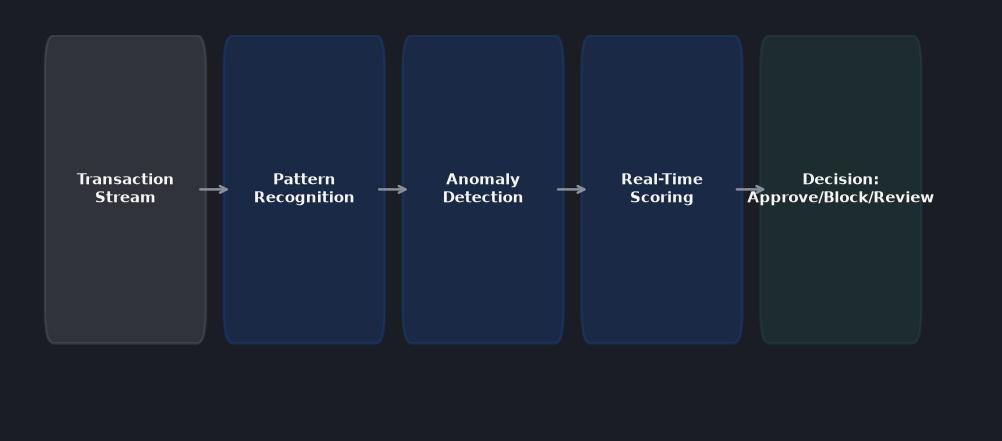
AI fraud detection combines three core technologies to identify suspicious patterns in real time:
Pattern Recognition
Machine learning models analyze millions of historical transactions to learn what "normal" looks like for each customer, merchant, and transaction type. When a transaction deviates from established patterns, the system flags it instantly.
Anomaly Detection
Unsupervised learning algorithms identify outliers that don't match any known pattern. This catches novel fraud schemes that rule-based systems miss entirely — the fraudster hasn't invented the technique yet, but the AI sees the anomaly.
Real-Time Scoring
Every transaction receives a risk score in under 50 milliseconds. The scoring engine evaluates 200+ variables simultaneously: device fingerprint, geolocation velocity, behavioral biometrics, merchant risk, transaction amount relative to historical baseline, and network analysis.
!AI fraud detection flowchart: transaction stream to decision
The Decision Layer
Based on the risk score, transactions are routed automatically:
- Score 0-30 (low risk): Auto-approved instantly
- Score 30-70 (medium risk): Flagged for manual review within 24 hours
- Score 70-100 (high risk): Blocked immediately, alert sent to fraud team
Key Use Cases Across Industries
Banking and Financial Services
Real-time transaction monitoring detects card-not-present fraud, account takeover attempts, and synthetic identity fraud. Banks using AI fraud detection report 40% reduction in fraud losses and 65% fewer false positives.
Insurance
AI analyzes claims data to detect staged accidents, inflated damages, and duplicate claims across policies. One insurer recovered $12M in fraudulent claims within the first year of AI deployment.
Retail and E-commerce
AI monitors return patterns, payment methods, and shipping addresses to detect refund fraud, chargeback abuse, and promotional exploitation. Retailers see 50% reduction in chargeback rates.
Healthcare
AI detects billing fraud, phantom billing, upcoding, and duplicate claims. The NHS estimated healthcare fraud at £1.2 billion annually — AI systems are cutting that by 35%.
The 4-Step Implementation Framework
Step 1: Build the Data Pipeline
Consolidate transaction data, customer profiles, device intelligence, and historical fraud cases into a unified data lake. Clean, labeled data is the foundation. Most enterprises have the data but haven't unified it.
Step 2: Select and Train Models
Start with a hybrid approach: rule-based filters for known fraud patterns, supervised ML for transaction classification, and unsupervised anomaly detection for novel threats. Train on at least 24 months of historical data.
Step 3: Tune Thresholds
Set risk score thresholds that balance fraud catch rate against false positive rate. Too aggressive, and you block legitimate customers. Too lenient, and fraud slips through. A 95% catch rate with under 5% false positives is a strong starting target.
Step 4: Human-in-the-Loop
AI handles 90% of decisions automatically. The remaining 10% — complex cases, edge cases, and new fraud patterns — go to human analysts. Their decisions feed back into the model, creating a continuous learning loop.
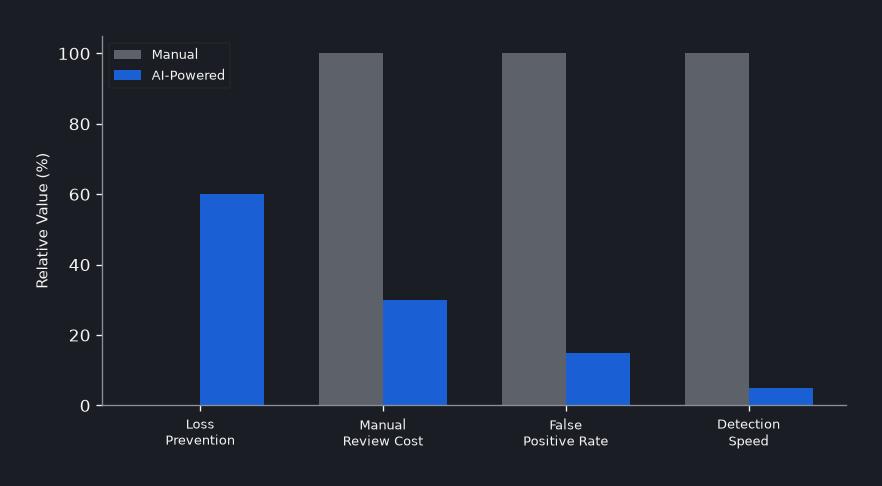
!ROI comparison: manual vs AI-powered fraud detection
ROI: What Enterprises Actually See
- 60% reduction in fraud losses within 6 months
- 70% reduction in false positives (fewer blocked legitimate transactions)
- 90% of transactions auto-decided with no human intervention
- $4.2M average annual savings for mid-sized enterprises
- 12-month payback period on AI fraud detection investment
The Cost of Waiting
Every day without AI fraud detection, enterprises lose money to undetected fraud. The math is straightforward: at 5% of revenue lost to fraud, a $100M enterprise is bleeding $5M annually. AI can recover $3M of that within the first year.
The technology is proven. The ROI is clear. The fraudsters are already using AI. The question is whether your enterprise will match their sophistication — or remain a target.
Sources: ACFE Report to the Nations, FTC Fraud Reports, NIST Cybersecurity Framework