AI Document Processing: How Enterprises Automate 80% of Unstructured Data in 2026
By Delos Intelligence — 2026-07-28
80% of enterprise data is unstructured. AI document processing with OCR, NLP, and entity extraction automates invoice processing, contract analysis, claims, and KYC. Here's the implementation roadmap.
The Unstructured Data Problem
McKinsey estimates that 80% of enterprise data is unstructured — locked in PDFs, emails, scanned images, contracts, invoices, and forms. This data contains critical business information, but it's invisible to traditional systems because it doesn't fit neatly into database rows.
Gartner research shows that knowledge workers spend 30% of their time searching for or re-creating information that already exists somewhere in the organization. The productivity drain is enormous.
AI document processing — also called Intelligent Document Processing (IDP) — is changing this. By combining OCR, NLP, and entity extraction, IDP systems can read, understand, and structure any document type with 94%+ accuracy.
How AI Document Processing Works
Stage 1: OCR and Digitization
Optical Character Recognition converts images of text into machine-readable text. Modern AI-enhanced OCR handles 40+ languages, multiple fonts, handwriting, and low-quality scans with 99%+ accuracy.
Stage 2: NLP Classification
Natural Language Processing models classify each document by type: invoice, contract, purchase order, claim form, KYC document, or correspondence. Classification takes under 2 seconds per document.
Stage 3: Entity Extraction
Named Entity Recognition (NER) models extract specific data points from each document. For an invoice, that means: vendor name, invoice number, line items, amounts, tax, payment terms, and due date. For a contract: parties, effective date, termination clauses, liability caps, and renewal terms.
!AI document processing pipeline: from ingestion to ERP integration
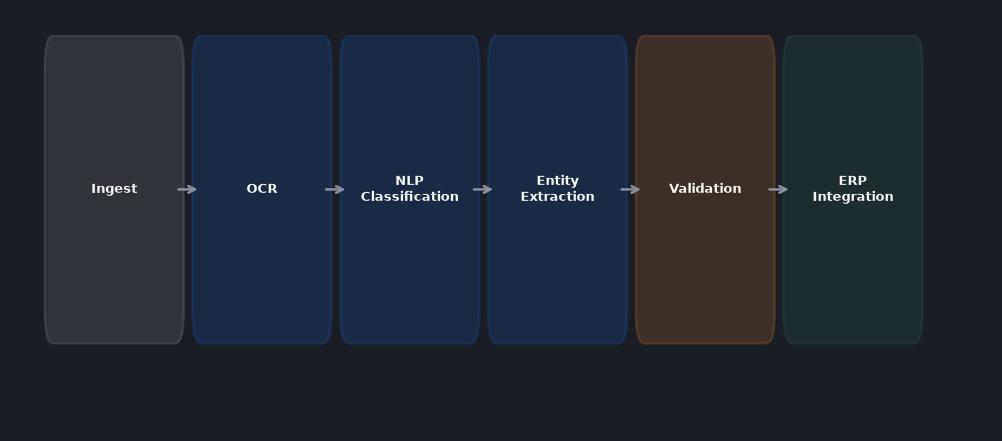
Stage 4: Validation and Integration
Extracted data is validated against business rules: does the invoice total match the line items? Is the vendor in the approved supplier list? Validated data flows directly into ERP, CRM, or workflow systems via API.
Key Use Cases
Invoice Processing
Automate accounts payable end-to-end: receive invoice, extract data, match to PO, route for approval, post to ERP. Enterprises report 80% reduction in processing time and cost per invoice dropping from $15 to $2.
Contract Analysis
AI reviews contracts for key clauses, risk terms, and compliance issues. Review time drops from hours to minutes per contract. During M&A due diligence, AI can screen 10,000+ contracts in days.
Claims Processing
Insurance companies use IDP to extract claim data, validate against policy terms, and auto-route for processing. Claim resolution time drops from 14 days to 3 days.
KYC and AML Compliance
AI extracts and verifies identity documents, cross-references sanctions lists, and flags suspicious patterns. KYC onboarding time drops from 5 days to 4 hours.
The 4-Phase Implementation Roadmap
Phase 1: Discovery (Weeks 1-3)
Audit your document volumes, types, and current processing costs. Identify the top 3 document types by volume and cost. These become your pilot candidates.
Phase 2: Pilot (Weeks 4-8)
Deploy IDP on one document type — typically invoices, since the ROI is clear and the data structure is well-defined. Run in parallel with manual processing for 60 days to validate accuracy.
Phase 3: Scale (Weeks 9-16)
Extend to additional document types. Integrate with ERP, CRM, and workflow systems. Train internal teams on exception handling. Most enterprises reach 80% automation by week 16.
Phase 4: Optimize (Ongoing)
Feed correction data back into the models. Expand to document types with more complex structures. Monitor accuracy, throughput, and cost metrics monthly.
!Manual vs AI-powered document processing comparison
ROI: What Enterprises Actually See
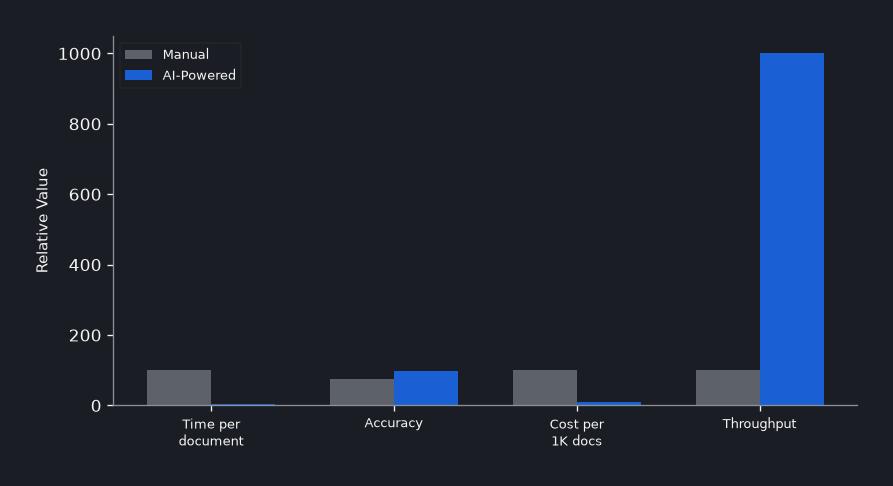
- 80% of unstructured data automated within 4 months
- 94% extraction accuracy (up from 75% manual)
- 85% reduction in processing cost per document
- 3x throughput increase with the same headcount
- $2.3M average annual savings for mid-sized enterprises
The Cost of Manual Processing
A mid-sized enterprise processing 50,000 documents per year at $15 per document is spending $750,000 annually on manual document handling. AI brings that cost to under $100,000 while improving accuracy and speed.
The NIST information extraction guidelines emphasize that structured data extraction is foundational to enterprise AI adoption. Without it, every downstream AI initiative — from analytics to automation — is starved of clean input data.