AI Data Quality: The Hidden Foundation of Every Successful Enterprise AI Deployment
By Delos Intelligence — 2026-07-29
68% of AI-first organizations have mature data quality frameworks. Learn the 5-pillar approach to AI data quality that reduces hallucinations by 73% and makes AI deployments trustworthy.
Why AI Data Quality Is the #1 Predictor of Enterprise AI Success
Every enterprise AI failure has a data story behind it. The chatbot that hallucinated customer policies was trained on outdated documentation. The fraud detection model that missed 40% of new attack vectors had a training set skewed toward legacy patterns. The hiring AI that systematically downgraded female candidates learned from a decade of biased historical decisions.
These aren't model problems. They're data quality problems. And they're the reason 74% of enterprise AI projects never make it past pilot.
IBM's 2024 Global AI Adoption Index found that 68% of AI-first organizations — those reporting significant competitive advantage from AI — have mature data quality frameworks in place. Among organizations struggling with AI adoption, only 14% had comparable data practices. The correlation is stark: data quality maturity predicts AI success more reliably than model choice, compute budget, or team size.
Yet most enterprises treat data quality as an IT operations concern — a checkbox for the data engineering team — rather than a strategic AI capability. This article changes that framing.
How AI Data Quality Differs from Traditional Data Quality
Traditional data quality asks: "Is this data accurate, complete, and consistent?" AI data quality asks a fundamentally different question: "Will this data produce models and agents that behave correctly in the real world?"
The distinction matters because AI systems don't just store and retrieve data — they learn from it, generalize from it, and make autonomous decisions based on patterns within it. A dataset can be 100% accurate by traditional measures and still produce a biased, unreliable, or hallucination-prone AI system.
!Traditional Data Quality vs AI Data Quality dimensions
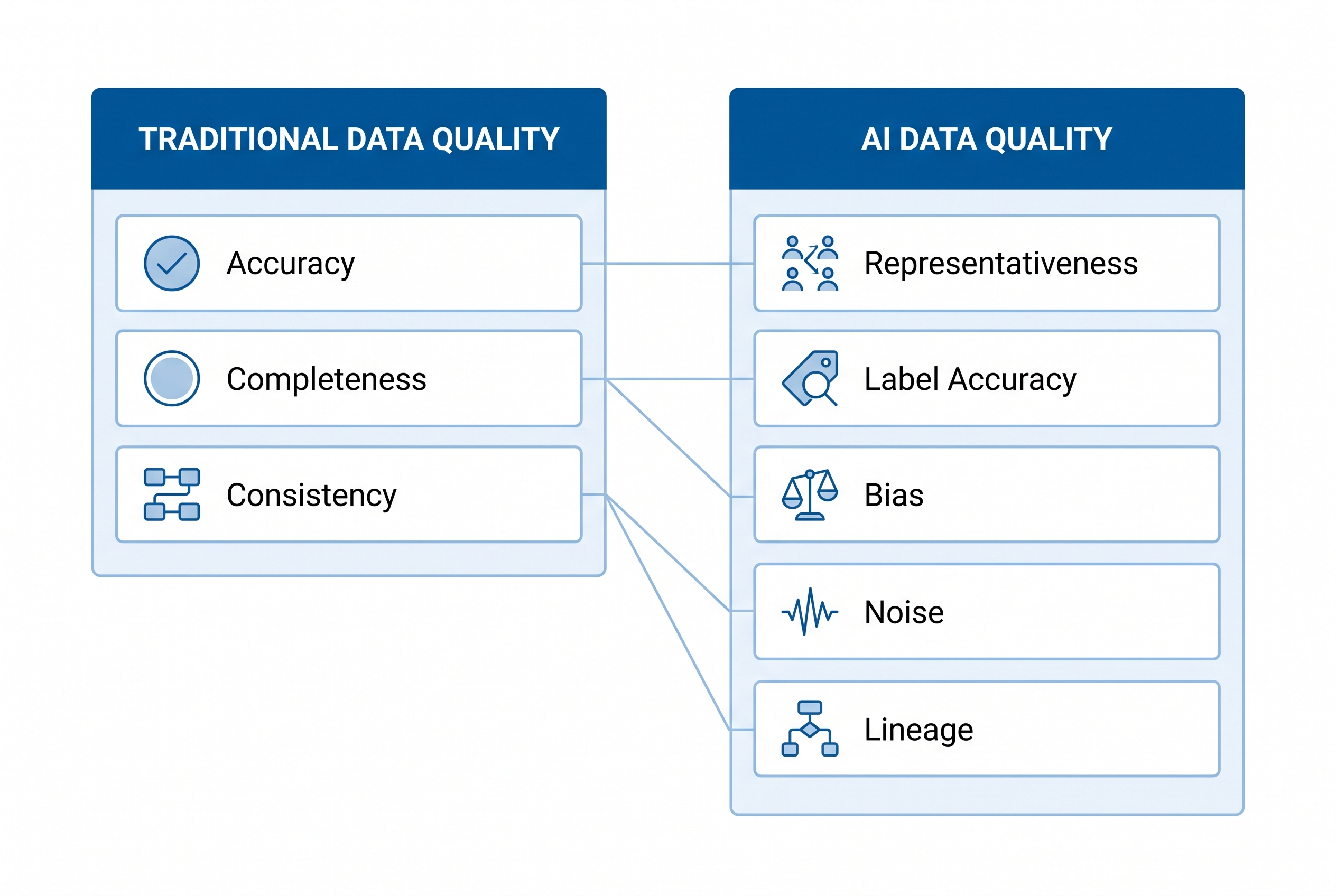
| Dimension | Traditional Data Quality | AI Data Quality |
|---|---|---|
| Accuracy | Does the value match reality? | Does the value + label match reality? |
| Completeness | Are all fields populated? | Is the dataset representative of real-world distribution? |
| Consistency | Do duplicate records agree? | Does the data produce consistent model behavior across segments? |
| Timeliness | Is the data current? | Are embeddings, features, and labels fresh enough for the model's context window? |
| Validity | Does the value match the schema? | Does the input fall within the model's training distribution? |
| Bias | Not measured | Is the dataset demographically and contextually representative? |
| Lineage | Optional metadata | Required for audit, debugging, and rollback |
| Noise | Tolerated within thresholds | Directly degrades model accuracy and must be quantified |
The last four rows — bias, lineage, noise, and representativeness — are where most enterprise AI data quality programs fail. Traditional tools don't measure them. Data teams don't own them. And yet they determine whether your AI agent gives a customer the right answer or a confident-sounding hallucination.
The 5-Pillar AI Data Quality Framework
!Five-pillar framework for AI data quality
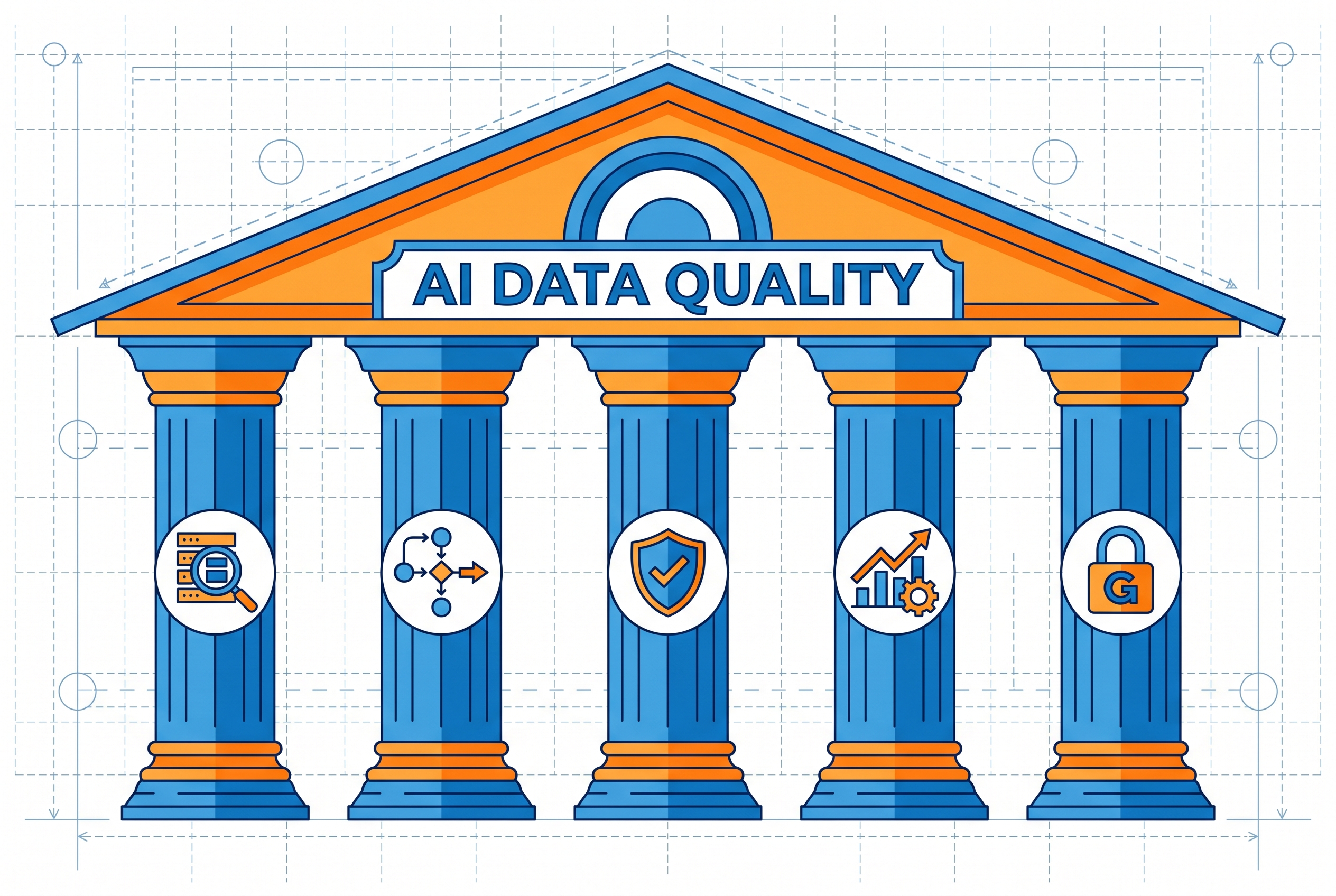
Pillar 1: Data Profiling & Discovery
Before you can improve data quality, you need to know what you have. Data profiling means systematically scanning every data source that feeds your AI pipelines — training datasets, RAG knowledge bases, feature stores, agent tool outputs — and documenting:
- Schema and field distributions: What fields exist, what values they contain, and how those values are distributed
- Anomaly detection: Outliers, impossible values, and statistically suspicious patterns
- Coverage gaps: Which segments, demographics, or edge cases are underrepresented
- Freshness: When was each data source last updated, and does it match the model's expected context window
Profiling is not a one-time activity. Every time a data source changes — a new CRM field, a restructured knowledge base, a modified API response — the profile must be refreshed. Automate profiling as a CI/CD step, not a quarterly audit.
Pillar 2: Lineage & Traceability
Lineage answers the question: "Where did this data come from, and what has happened to it since?" For AI systems, lineage must track:
- Source provenance: Which system, API, or human process generated this data
- Transformation history: Every join, filter, aggregation, or enrichment applied
- Model usage: Which models or agents consumed this data, and when
- Impact analysis: If this data source is modified, which downstream models are affected
Lineage is your rollback insurance. When a model starts hallucinating, lineage tells you which data source changed and when — turning a multi-day debugging session into a 15-minute lookup.
Pillar 3: Automated Validation
Manual data review doesn't scale. Automated validation runs quality checks as part of the data pipeline, before data reaches the model or agent:
- Schema validation: Does the incoming data match the expected schema?
- Range and type checks: Are numeric values within plausible bounds? Are categorical values from the expected set?
- Cross-field consistency: Does `order_date` precede `ship_date`? Does `customer_age` match `account_creation_date`?
- Distribution drift detection: Has the statistical distribution of a key field shifted beyond a defined threshold since the last model training?
- Bias checks: Is the demographic distribution of a training batch within acceptable bounds of the target population?
Validation rules should be versioned, tested, and deployed through the same CI/CD pipeline as application code. A validation failure should block the pipeline — not generate a warning that gets ignored.
Pillar 4: Continuous Monitoring
Data quality in AI is not a state — it's a trajectory. A dataset that was clean at training time degrades over time as the world changes. Continuous monitoring tracks:
- Model performance drift: Is the model's accuracy, precision, or recall degrading week-over-week?
- Data distribution drift: Are input features shifting away from the training distribution?
- Hallucination rate: For LLM-based agents, what percentage of outputs are flagged as hallucinations by automated or human checks?
- Feedback loop health: Are user corrections and thumbs-down signals trending upward?
Monitoring should trigger alerts when drift exceeds defined thresholds — not after the model has degraded, but before. Set thresholds at 2 standard deviations from baseline, and investigate every alert.
Pillar 5: Governance & Ownership
Data quality without ownership is a tragedy of the commons. Every data source that feeds an AI system must have:
- A data owner (a named individual, not a team) responsible for its quality
- A quality SLA defining acceptable thresholds for each quality dimension
- An escalation path when quality drops below SLA
- A review cadence (monthly for critical sources, quarterly for others)
Governance also means access control: who can modify training data, who can update knowledge bases, who can change feature definitions. Every change should be logged, reviewed, and reversible.
Common Data Quality Failure Modes in AI Pipelines
Understanding how data quality fails in AI systems helps you build preventive controls:
Stale Embeddings
Your RAG knowledge base was embedded 6 months ago. Since then, 30% of the documents have been updated, 10% have been removed, and 15 new documents have been added. The embeddings no longer match the source documents, so the agent retrieves outdated or contradictory information.
Prevention: Re-embed on a schedule tied to document change frequency. Monitor the delta between embedding timestamps and document modification timestamps.
Biased Training Data
A customer support AI was trained on 3 years of ticket data. The data overrepresents English-speaking customers (82% of tickets) and underrepresents Spanish-speaking customers (4%). The agent performs well for English queries and poorly for Spanish queries — but aggregate accuracy looks fine because English dominates the sample.
Prevention: Segment performance reporting by demographic and language dimensions. Set minimum representation thresholds for training data.
Broken Lineage
A feature store was modified by a data engineer who didn't update the lineage documentation. Three models depend on this feature. When the feature definition changes, all three models degrade — but no one knows which feature caused it because the lineage is stale.
Prevention: Automated lineage tracking that updates on every pipeline change. Manual lineage documentation is always stale.
Fragmented Metadata
Training data is stored in S3, labels in a separate labeling tool, feature definitions in a feature store, and model versions in MLflow. None of these systems share a common identifier, making it impossible to trace which data produced which model.
Prevention: A unified metadata layer that links datasets, labels, features, and models through shared identifiers.
Real-World ROI: 73% Hallucination Reduction
A mid-size financial services company (1,200 employees, €200M revenue) deployed an AI agent for internal policy Q&A using RAG over their corporate wiki. Initial deployment showed a 14% hallucination rate — the agent would confidently answer questions about policies that didn't exist or had been superseded.
The root cause was data quality: the wiki contained duplicate documents with conflicting versions, outdated policies that hadn't been archived, and documents with broken cross-references. The model was doing exactly what it was trained to do — retrieving and synthesizing — but the source data was unreliable.
The company implemented the 5-pillar framework over 8 weeks:
1. Profiling identified 340 duplicate documents and 87 outdated policies
2. Lineage tracked which documents fed which RAG queries
3. Validation blocked documents missing required metadata fields from entering the knowledge base
4. Monitoring tracked hallucination rate per document cluster
5. Governance assigned document owners and required quarterly reviews
After implementation, the hallucination rate dropped from 14% to 3.8% — a 73% reduction. The agent became trustworthy enough for production use, and employee adoption increased 4x. The total investment was 6 person-weeks of engineering time — a fraction of the cost of the hallucination-related incidents it prevented.
Implementation Roadmap: 12 Weeks to Production AI Data Quality
Phase 1: Discovery & Assessment (Weeks 1-3)
- Inventory all data sources feeding AI pipelines (training data, RAG bases, feature stores, tool outputs)
- Run automated profiling on each source
- Identify the top 5 quality issues by impact on model performance
- Assign data owners for each critical source
- Establish baseline metrics for hallucination rate, drift, and bias
Phase 2: Foundation Building (Weeks 4-7)
- Implement automated validation rules for the top 5 data sources
- Deploy lineage tracking (start with critical paths, not exhaustive)
- Set up continuous monitoring dashboards for model performance and data drift
- Define quality SLAs for each critical data source
- Build the alerting pipeline (Slack/email notifications on threshold breach)
Phase 3: Integration & Automation (Weeks 8-10)
- Integrate validation checks into CI/CD pipelines for data and model updates
- Automate re-embedding schedules for RAG knowledge bases
- Implement bias detection for training data batches
- Connect feedback loops (user corrections, thumbs-down) to monitoring dashboards
- Build rollback procedures for data and model changes
Phase 4: Governance & Scale (Weeks 11-12)
- Establish the data quality review cadence (monthly for critical sources)
- Train data owners on quality monitoring and escalation procedures
- Expand profiling and validation to secondary data sources
- Document the framework and create runbooks for common quality incidents
- Present results to stakeholders with before/after metrics
Best Practices for Maintaining Data Quality in Production
RAG Pipelines
- Re-embed documents on a schedule tied to change frequency, not a fixed calendar
- Validate document metadata before ingestion (required fields, format checks)
- Monitor retrieval quality: are the top-k retrieved documents actually relevant to the query?
- Deduplicate documents before embedding to avoid contradictory retrievals
- Version your embeddings: tag each embedding batch with a timestamp and source snapshot
Agent Workflows
- Validate tool outputs before passing them to the agent's reasoning loop
- Log every data input the agent receives with full lineage for audit
- Monitor for distribution drift in tool outputs (API response schemas change)
- Implement circuit breakers: if a data source starts returning malformed data, pause agent calls to that source
Model Retraining
- Never retrain on unvalidated data — run the full validation suite before each training run
- Compare the new training set's distribution to the previous one; investigate any drift
- Maintain a holdout set of known-good examples to test model quality after retraining
- Version datasets with the same rigor as code: every training run should reference a specific, immutable dataset version
The Bottom Line
AI data quality is not a technical concern. It's a business capability. The organizations that treat it as such — with dedicated owners, automated controls, and continuous monitoring — are the ones whose AI deployments deliver reliable, trustworthy results.
The 68% of AI-first organizations with mature data frameworks aren't smarter than you. They just started earlier. The 5-pillar framework gives you the blueprint. The 12-week roadmap gives you the timeline. The rest is execution.
Start with one data source, one model, one quality SLA. By week 12, you'll have the foundation that every successful AI deployment is built on.